War Emergency Backpack 2026: What to Pack
Build your plan for Conflict
Free, no sign-up, takes 5 minutes.
Quick answer: A war emergency backpack should include 6 litres of water per person, food for 72 hours that needs no cooking, laminated documents, cash in small notes, a battery or wind-up radio, an LED head torch, a basic first aid kit with your medication, layered warm clothing, a foil blanket and a multi-tool. Maximum weight: 12 to 15 kg (20% of body weight).
In March 2026, the government of Cyprus did something few European governments had done in a long time: it asked its citizens to keep a bag packed and ready to leave at a moment’s notice. It wasn’t a PR exercise. A drone had struck RAF facilities at Akrotiri (a British Sovereign Base Area) and tension across the eastern Mediterranean had been running high for weeks. The United States raised its travel advisory to “reconsider travel to Cyprus.” The island sits 250 kilometres from Syria.
That week, the question doing the rounds wasn’t “could this happen to me?”. It was far more concrete: if I had to leave home in ten minutes, what do I put in the emergency backpack for war or conflict?
This guide answers that. Without alarmism or exaggeration. The same backpack that prepares you for a conflict works for flooding, a wildfire, or a prolonged loss of supplies. And recent years across Britain and Europe have made it clear you don’t have to look far to need one. At EmergencyKitLab UK we treat this as the most versatile kit you can own.
Why Cyprus and Europe Are Talking About Emergency Backpacks
Cyprus isn’t the only case. Since 2025, the European Commission has been recommending that member states encourage citizens to keep a 72-hour kit ready. Sweden, Germany and the Baltic states had campaigns running before that. France published its own guide. Across the UK, the gov.uk Prepare site and Local Resilience Forums have stepped up their household-readiness messaging.
The common thread running through all these initiatives is the same: emergency services need time to organise. During those first hours — often more of them than we imagine — the person who has to handle the basics is you.
The Cypriot case adds a concrete twist: the backpack has to be physically carried to a shelter, not just used to ride things out at home. That changes what you prioritise.
If you want to understand the difference between a home kit and an evacuation backpack, you’ll find the breakdown in our emergency kit for civil conflict.
The Difference Between the Home Kit and the Evacuation Backpack
A home kit can weigh whatever you like. Water for two weeks, tins for a month, a generator in the shed. It doesn’t matter, because you don’t have to carry it.
The evacuation backpack is another story.
It has to hang off your back while you walk fast, climb stairs, or hold a child by the hand. The limit survival experts and the Red Cross use is clear: no more than 20% of your body weight, around 12 to 15 kg for a fit adult. Go over that and you’ll be shedding things along the way.
There’s a quick test to check before you ever need it: load the backpack and run for two minutes. If you regret picking it up within the first minute, there’s too much in there.
What to Pack in the War Emergency Backpack — The Complete List
Quick list, war emergency backpack (per person):
- Water: 6 litres in bottles + purification tablets
- Food: 72h of food that needs no cooking (1.2 to 1.5 kg)
- Documents: passport, NHS details, small cash, medical summary
- Battery or wind-up radio with USB
- LED head torch
- Charged power bank (min. 20,000 mAh)
- Basic first aid kit + regular medication with prescription
- Layered warm clothing (2 days) + foil blanket
- Waterproof jacket or poncho
- Multi-tool, lighters (x2), gaffer tape, whistle
Survival training schools, the European Commission and the Cypriot government’s guidance all agree on the basic items. Here’s each category with the details.
Water and Purification
The minimum: three litres per person per day. For 72 hours that’s nine litres, nine kilos in water alone. The practical solution: carry six litres in bottles and a purification system as backup for the rest.
Purification tablets are the lightest option there is. Aquatabs and similar cost around £10 on Amazon.co.uk and treat one litre per tablet in 30 minutes at room temperature. In cold water, they can need up to two hours. And here’s something that surprises a lot of people: they don’t remove sediment. If the water’s cloudy, you have to filter it first — a tightly woven cloth will do.
For situations where weight is critical, the Sawyer Mini filter is a compact alternative weighing under 90 g that filters huge volumes. It fits in any side pocket.
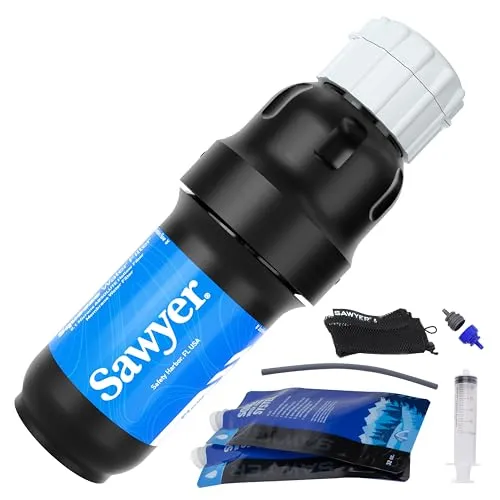
Sawyer PointOne Squeeze Filtration System
Filters huge volumes, removing 99.99999% of bacteria and protozoa. Weighs under 90 grams
Relying on tablets alone with no water in reserve isn’t a plan. If it takes you more than 72 hours to reach somewhere safe, you need options.
Food for 72 Hours
The rule: 2,000 calories per person per day, in things that need no cooking.
What works well:
- Tins with a ring-pull lid (no tin opener needed)
- Energy bars
- Nuts, dried fruit
- Oatcakes or crackers
What doesn’t work: freeze-dried food that needs boiling water, because in a real evacuation you may have no way to make a fire. No glass jars either.
The weight of three days of well-chosen food comes to around 1.2 to 1.5 kg for an adult.
Essential Documents
The section people neglect most, and the one that causes the most problems afterwards.
The people evacuated in the major floods of recent years who carried laminated documents could identify themselves and access support without delays. Those who hadn’t, waited days.
The minimum:
- Passport or driving licence: original plus a laminated copy in a waterproof bag
- NHS details (number, key medical info)
- A medical summary if you take regular medication
- Cash in small notes: £5, £10 and £20. Cash machines collapse in widespread outages
- A digital copy in the cloud: the phone can get wet, lost or broken
A waterproof zip bag costs under £2 and protects all of this.
Communication and Lighting
The battery or wind-up radio is the single most important item in the whole war emergency backpack. Not the phone.
In a mass crisis, mobile networks fall over. AM/FM radio keeps working as long as stations are broadcasting, and public-service stations run backup generators. Look for a model with a USB output to charge the phone. They cost £25-40 on Amazon.co.uk and weigh under 400 g. One minute of cranking gives 20 to 30 minutes of listening.
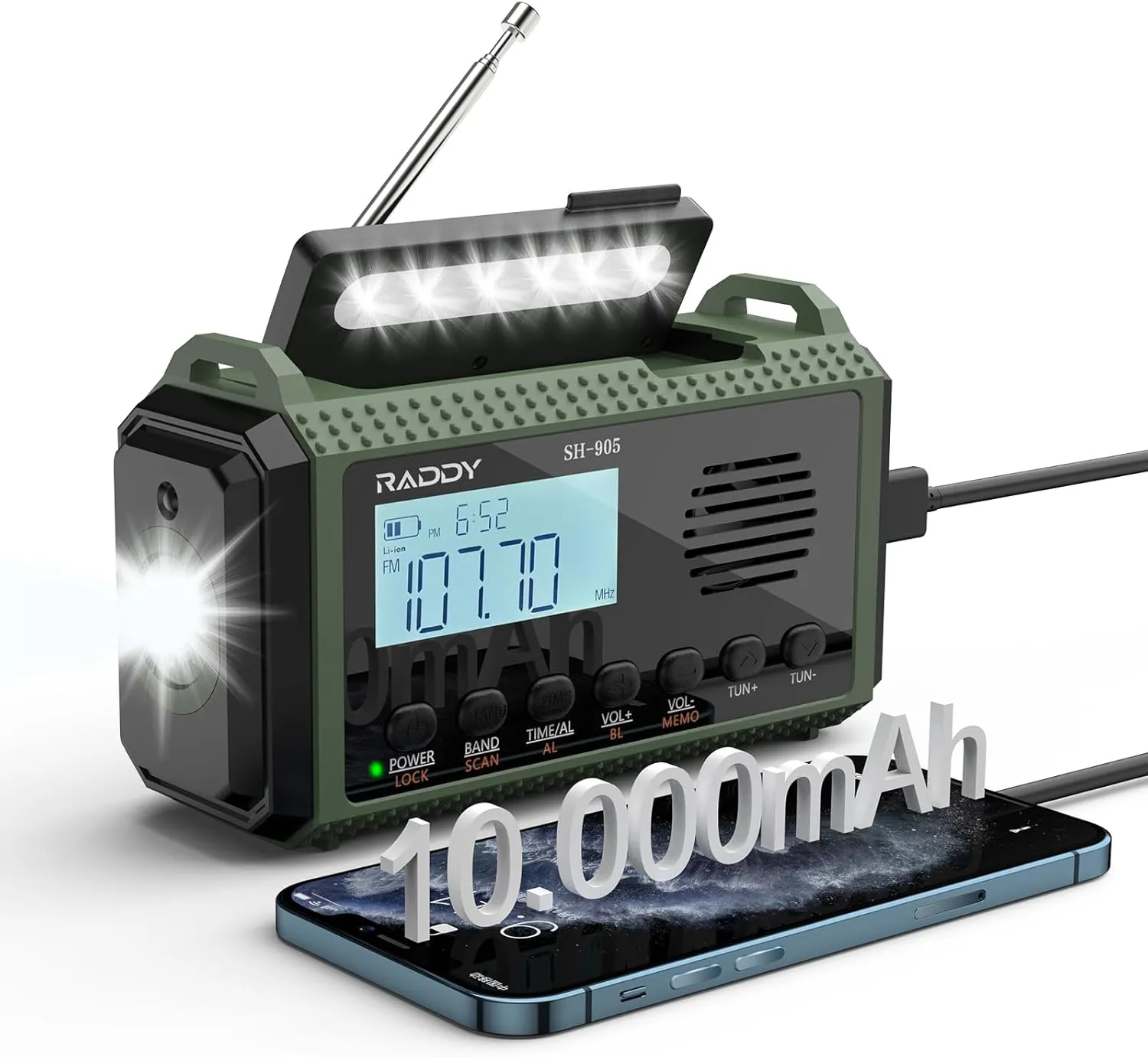
Raddy SH-905 Solar Radio 10000mAh
Emergency radio with a 10,000 mAh battery. Solar, crank and USB charging. Receives AM/FM/SW and charges your phone
The rest of the communication block:
- An LED head torch: hands free for whatever you need
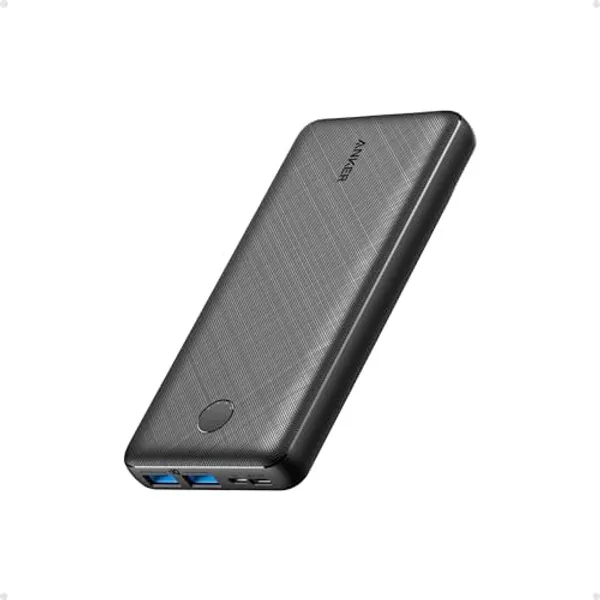
Anker PowerCore 20000mAh USB-C
20,000 mAh to charge your phone 4-5 times. Essential when there's no power for hours on end
- A secondary pay-as-you-go phone: data contracts can drop before voice does
First Aid and Medication
The basics: antiseptic, bandages, plasters, painkillers (paracetamol and ibuprofen), oral rehydration salts, tweezers.
The rule with no exceptions: you carry exactly the medication you take, with a laminated copy of the prescription. If a medicine needs refrigeration, talk to your GP about alternatives before you need that conversation mid-emergency.
An oral antihistamine takes up no space and can save you a nasty surprise in unfamiliar surroundings.
Clothing and Protection
The principle: two days of layered clothing, not a full outfit per day.
What you include:
- A change of underwear
- A warm layer (a lightweight fleece)
- A waterproof jacket or compact poncho
- Wool or thermal socks
- A compact foil blanket: 80 grams, under £3, and potentially decisive on a cold night
The footwear you have on when you evacuate is critical. The recent flood evacuations happened in the small hours. Hard-soled shoes within reach of the bed: a detail that doesn’t seem important until it is.
Basic Tools
- A multi-tool: knife, screwdriver, tin opener in one object
- Two lighters: at least one in an outside pocket
- Large bin bags: waterproof the contents, collect rainwater, double as a poncho in a pinch
- Gaffer tape: repairs, sealing, improvising
- A whistle: for signalling when you can’t shout or visibility is poor
What Backpack to Buy for Your Evacuation Kit
Before you pack anything, you need the container. The right backpack is the difference between a functional kit and a back injury.
What you want: 35 to 45 litres, a MOLLE system for adding outer pockets, a padded back if you’ll carry it loaded, and a dark or neutral colour. No school or sports bags.
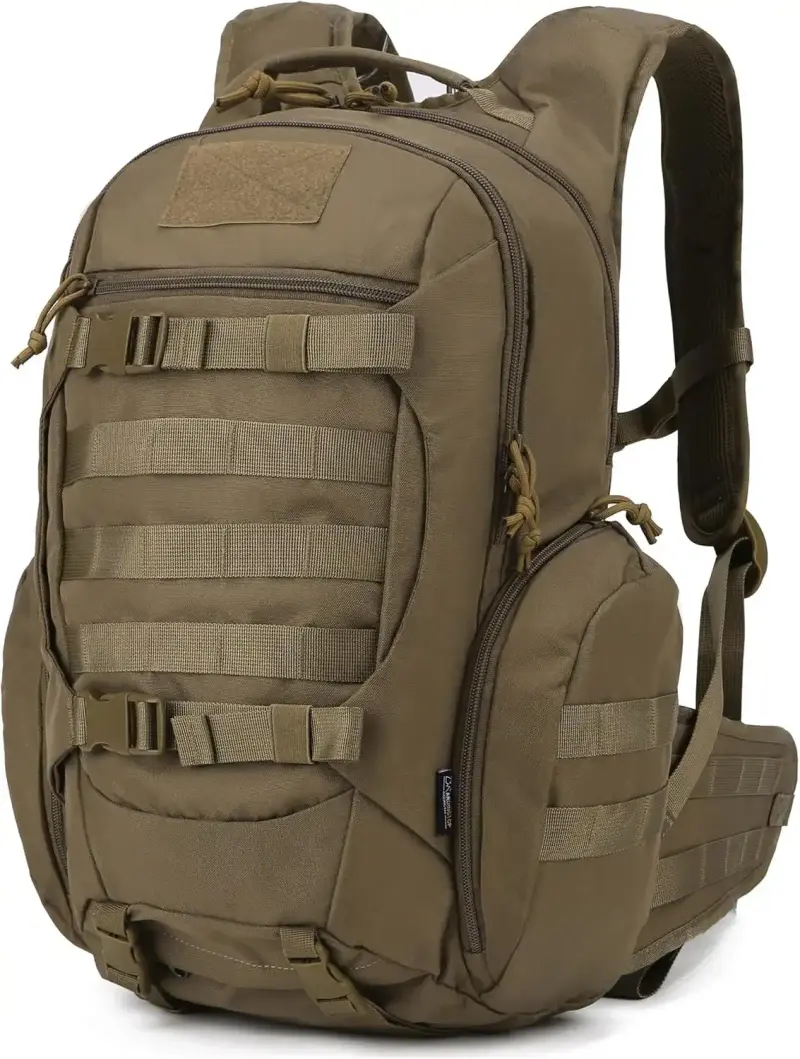
Mardingtop 35L Tactical Military MOLLE Backpack
35L with a full MOLLE system. The ideal size for a 72h individual kit without exceeding the weight limit
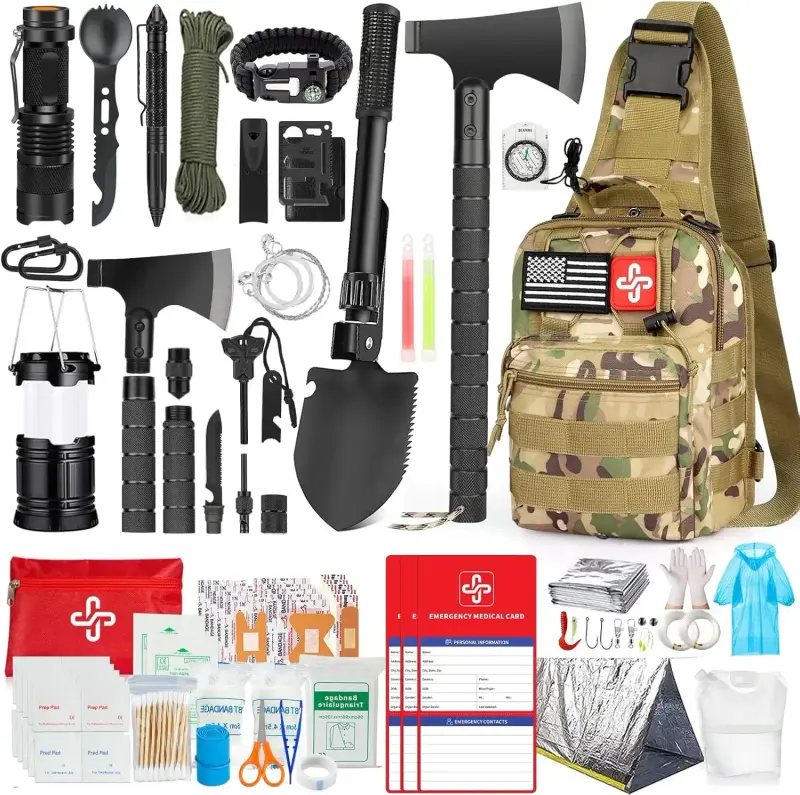
262-Piece Complete Survival Kit
262 pieces with first aid kit, tent, axe and shovel. For anyone who'd rather have a ready-made kit with nothing to assemble
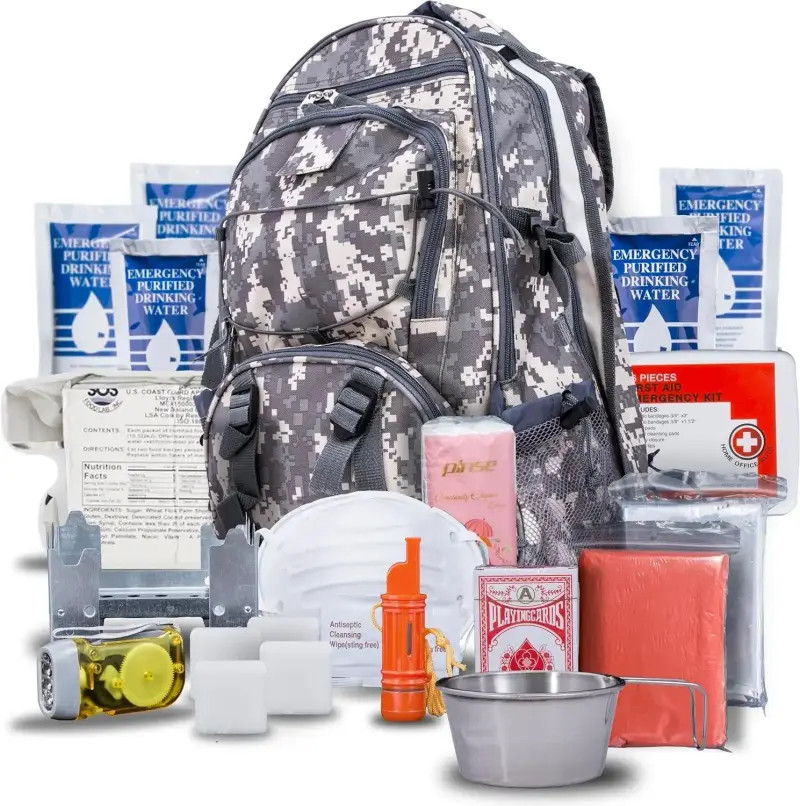
Blue Seventy-Two Pro Series Camo Deluxe 72-Hour Kit
A professional 72h kit with purification tablets, food, first aid and signalling. Assembled and ready
How to Organise the Backpack
Fifteen seconds to pull out the torch in the dark. If you have to empty the backpack to find it, the packing order is wrong.
What works:
Bottom layer: clothing, blanket, solid food. The things you don’t need urgently. Middle layer: water, first aid kit, tools. The things you need within minutes. Outer pockets and top: torch, documents, cash, tablets, power bank. The things you need within seconds.
Heavy items go close to your back. Dry bags inside the backpack for electronics and documents. A backpack with no rain cover can soak through in 15 minutes of real British rain.
If you want the process in more detail, there’s a full guide in our 72-hour survival bag checklist.
The Mistakes That Come Up Most Often
Overloading. The most common error. People pack things “just in case” and end up with 25 kilos. The two-kilometre test doesn’t lie.
Forgetting regular medication. One of the most frequently forgotten items in real evacuations. A list taped to the backpack helps: as you leave, one final check — “medication: yes or no?”.
Having no cash. When the network goes down, the card is useless. Cash machines are among the first to collapse.
Trusting the phone alone for maps. A smartphone under heavy use (GPS, calls, 4G) lasts about six hours. Carry a physical OS map of your area.
Not checking the backpack every six months. Bottled water expires. So do the tablets. Lighters empty. The power bank self-discharges on its own. A six-monthly review in the calendar and you’re sorted.
A brightly coloured backpack. In tense situations, going unnoticed has real value. Dark or neutral colours.
The Same Backpack Works for Ten Different Situations
The backpack designed for an armed conflict is exactly the one you need for flooding, a wildfire, an extreme snowstorm, or an earthquake. There aren’t two separate lists. It’s the same one.
In the UK, the chance of having to evacuate for a natural hazard — flooding above all — is considerably higher than finding yourself in the middle of an armed conflict. People evacuated from floods have often had only minutes. From wildfires, sometimes less.
Preparing for the extreme leaves you prepared for the probable.
To pair the backpack with a family action plan, see how to make a family evacuation plan step by step.
About this article: At EmergencyKitLab UK we regularly review guidance from gov.uk, Local Resilience Forums, the European Commission and international emergency bodies. Last reviewed: May 2026. In a real emergency, always follow the instructions of 999 and your local authorities. EmergencyKitLab UK participates in the Amazon EU Associates Programme: when you buy through our links, we receive a small commission at no extra cost to you.
Prices are indicative and may vary on Amazon.
Looking for products mentioned in this article?
Products reviewed by our team on Amazon, all rated 4+ stars.
Build your plan for Conflict
Exact quantities, verified products, and a personalized shopping list for Conflict. Free in 5 minutes.
Plan for ConflictUK emergency preparedness editorial team
The EmergencyKitLab UK editorial team produces straightforward preparedness advice for British households facing Atlantic storms, flooding, power cuts, cold snaps and heatwaves. We focus on affordable steps that work in typical UK homes, including flats with limited storage.
Frequently Asked Questions
What should a war emergency backpack contain?
How much should an evacuation backpack weigh?
How does a war backpack differ from a home kit?
What documents should I carry in the emergency backpack?
How often should I check the emergency backpack?
Related Articles
Best 72-Hour Survival Backpack 2026: £40 Beats £150
EmergencyKitLab UK 2026 test: 5 survival backpacks compared. The £40 pick outlasts £150 models, holds 12 kg — and the one you should skip.
12 min read72-Hour Survival Bag: Complete Checklist Organized by Weight
What to pack in your 72-hour survival bag and how to organise it so you can find everything in the dark. Full checklist with real weights and priority order.
9 min read7 Emergency Radios Tested: Only 2 Survive 48h Without
7 emergency radios tested in 2026: only 2 last 48h without recharging. After Hurricane Helene, we compared real battery life starting at £25.
12 min read