NRG-5 vs Trek'n Eat: 72-Hour Emergency Food Compared
Build your personal emergency plan
Free, no sign-up, takes 5 minutes.
NRG-5 vs Trek’n Eat is the question anyone asks once they start filling out the food section of their EmergencyKitLab UK kit. Both are respected references on the European market, both are marketed for 72-hour and longer emergency scenarios, and both have long shelf lives. But behind the shared “emergency food” label sit completely different philosophies. At EmergencyKitLab UK we tested both during the spring 72-hour bag drill the team runs each year, and the conclusion surprised us.
This comparison between NRG-5 and Trek’n Eat looks at calories, weight, water needed, real-world taste and cost per day. At the end you get a clear recommendation by scenario: an evacuation bag, a household kit, a long-term reserve or proper outdoor use.
Comparison table: NRG-5 vs Trek’n Eat
| Spec | NRG-5 (500 g ration) | Trek’n Eat Chilli con Carne |
|---|---|---|
| Calories per unit | 2,300 kcal | 700 kcal |
| Weight per unit | 500 g | 175 g |
| Calorie density | 4.6 kcal/g | 4.0 kcal/g |
| Water required | 0 ml (optional) | 450 ml boiling |
| Prep time | Instant | 8–10 min |
| Stated shelf life | 20 years | 7–12 years |
| Format | Compact bars | Foil pouch (self-heating optional) |
| Flavours available | 1 (neutral biscuit) | 15+ recipes |
| Provides animal protein | No | Yes (some recipes) |
| Price on Amazon UK | ~£9 (500 g) | ~£11 (170 g) |
| Cost per 1,000 kcal | £3.90 | £15.70 |
| Amazon rating | 4.3 / 5 | 4.2 / 5 |
The number that jumped out when we built the table: NRG-5 costs roughly four times less per calorie. And it needs no water. For a 72-hour emergency where water can be the scarcest resource, that single fact changes the calculation entirely.
NRG-5 Pack of 24 in detail
NRG-5 is the official survival ration of several European armed forces. It is made by MSI (Multifoodtec) in Germany to Bundeswehr specifications for humanitarian missions. Each 500 g pack contains nine compact bars delivering 2,300 kcal between them. The texture is similar to a dense ship’s biscuit, the flavour is neutral with a hint of coconut-grain, and there is no added sugar. It is free of common allergens (no lactose, no egg, no nuts).
What the team likes:
- 2,300 kcal per person per day in 500 g of weight, an unbeatable ratio
- Zero water required to eat it, critical when mains water is off
- 20-year shelf life with no special conditions (perfect for a forgotten reserve)
- A pack of 24 covers 24 person-days or six days for a family of four
- International humanitarian use: if it works in refugee camps, it will work for you
Where it falls short:
- Monotonous taste; three days of pure NRG-5 is psychologically tough (the team confirmed it on the March drill)
- Dry texture means you drink water while chewing (no more than you would normally, but it is not “fresh” food)
- No animal protein, so for sustained use over a month you need to combine with other sources
- No warmth on consumption; in cold weather you miss a hot meal more than usual
Best for: a long-term household backup (5 to 20 years), a 72-hour bag where you do not want to depend on stove plus water plus time, an urban evacuation bag where you cannot light a fire.
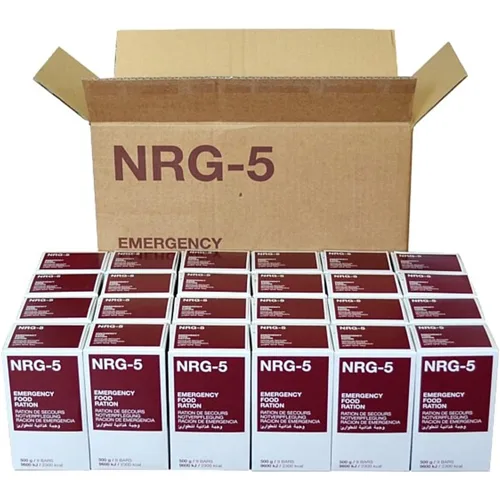
NRG-5 Pack of 24 Rations
Pack of 24 certified survival rations (24x500 g) for emergencies. 55,200 kcal total. 20-year shelf life. No water needed. European humanitarian standard.
Trek’n Eat Chilli con Carne in detail

Trek’n Eat is the European premium freeze-dried outdoor food brand, owned by the German Katadyn group (the water filter people). Freeze-drying preserves cooked meals (stews, curries, pasta dishes) at around 20% of their original weight. Add boiling water and the food reconstitutes in 8–10 minutes, recovering surprisingly similar texture and flavour to the original dish.
What the team likes:
- Menu variety: 15+ recipes avoids the day-two-and-three taste fatigue
- Real animal protein (beef, chicken) in many products, useful for sustained use
- A hot meal at the end of a tough day has real moral value under stress
- Decent nutritional profile against tinned food (less sodium, more protein per gram)
- Optional self-heating pouches for a hot meal without a stove
Where it falls short:
- Requires 400–500 ml of boiling water per pouch, so stove, water and fuel are non-negotiable
- Cost per calorie is roughly four times that of NRG-5
- Shorter shelf life (7–12 years) demands a more active rotation
- 4.2 stars with around 119 reviews on Amazon UK, a smaller user base
Best for: an outdoor multi-day backpacking bag (low weight, real food), a household kit with active rotation where the family eats the pouches as a weekend meal every couple of years, or an emergency where you can boil water without restrictions.
Trek'n Eat Chilli con Carne
Freeze-dried meal with real beef, one of the more palatable recipes in the catalogue. 700 kcal per 175 g pouch. Ready in 10 minutes with boiling water. Eight-year shelf life.
Check price on Amazon UKWhich one for your situation
The honest answer is almost never “just one”. But if you have to decide:
You are building a 72-hour bag on a tight budget: NRG-5. For about £27 you cover three person-days without depending on a stove or extra water. The weight (1.5 kg) is similar to six Trek’n Eat pouches that would cost around £66. The £40 difference can go into a water filter or a torch.
You take the bag hill-walking on weekends and want a dual-purpose kit (real use + emergency): Trek’n Eat. Recipes are acceptable as bivvy dinners, you will rotate the stock annually, and you do not need a 20-year shelf life because you consume and replace.
You are building a household reserve for long scenarios (extended power cut, supply disruption): combination. NRG-5 as the unalterable nutritional anchor + Trek’n Eat for psychological variation + supermarket tinned food + rice and pulses. We cover this in the 72-hour family emergency kit guide.
You live in an area with frequent water or gas disruption (rural Scotland, parts of Wales after floods): NRG-5. The “zero water to consume” factor is not theoretical: in some council water cuts the supply is on but not potable, and bottled gas takes 48 hours to restore.
You have children or older relatives who reject unusual textures: neither is ideal, but Trek’n Eat with familiar recipes (pasta bolognese, chicken rice) has better acceptance than the neutral flavour of NRG-5. Acceptance matters: food that does not get eaten is not a reserve, it is dead weight on the shelf.
The EmergencyKitLab UK team verdict
For a first purchase aimed at real emergencies, EmergencyKitLab UK recommends NRG-5. The combination of cost per calorie, 20-year shelf life and independence from water and heat makes it the most reliable nutritional anchor for supply disruption scenarios. It is the product the team would put in a bag if forced to pick only one.
Trek’n Eat has its place but not as a sole option. It is complementary: it adds variety, morale and real animal protein when conditions (water + heat) allow. The team rejected basing a 72-hour reserve solely on freeze-dried meals because the dependence on stove + water + time creates a single point of failure.
An honest observation after the March 72-hour bag drill: NRG-5 fatigue hits on day three. Eating the same neutral biscuit for breakfast that you ate for dinner four times running, your body chews through it but your head resists. The strategy that worked best: two days of NRG-5 as the base + one or two Trek’n Eat pouches per day as a hot “reward” at the end. Not the cheapest, but the most realistic for sustaining morale in a prolonged scenario. Cost for one person for a week: around £55 to £65, weight 2.5 kg, all in formats compatible with a standard bag.
Key concepts for designing your food reserve
Before spending £200 on emergency rations, read 72-hour emergency kit for families, which explains which everyday supermarket products do half the job at a third of the cost, and our wider emergency food supply guide for how to size the reserve by household and days of autonomy.
To understand why freeze-dried food is not the universal solution some retailers claim, the lessons from a 5-day blackout article has the real numbers on cost, weight and palatability when the stove ran out of gas on day three.
How many calories does your family need by size and days of autonomy? The EmergencyKitLab UK planner calculates the exact reserve and splits weight across survival rations, freeze-dried meals and local tinned food.
Some links are Amazon affiliate links, at no extra cost to you. Prices and ratings were verified in May 2026 and may vary.
Prices are indicative and may vary on Amazon.
Looking for products mentioned in this article?
Products reviewed by our team on Amazon, all rated 4+ stars.
UK emergency preparedness editorial team
The EmergencyKitLab UK editorial team produces straightforward preparedness advice for British households facing Atlantic storms, flooding, power cuts, cold snaps and heatwaves. We focus on affordable steps that work in typical UK homes, including flats with limited storage.
Frequently Asked Questions
Do you need to cook NRG-5 rations or can they be eaten dry?
How much water does a Trek'n Eat pouch need to rehydrate?
How many daily calories does an NRG-5 pack give compared to a Trek'n Eat menu?
Which has the longer unopened shelf life?
Is Trek'n Eat actually palatable for someone who is not used to camping food?
Related Articles
72-Hour Emergency Kit 2026: Checklist + Budget (Family)
EmergencyKitLab 2026 guide: complete 72-hour kit checklist from £50/person. Winter Storm Uri-tested tips + the #1 water mistake families still make.
15 min read72-Hour Survival Bag: Complete Checklist Organized by Weight
What to pack in your 72-hour survival bag and how to organise it so you can find everything in the dark. Full checklist with real weights and priority order.
9 min read5-Day Blackout: Real Lessons from Losing Power for a Week
True account of a 5-day power outage: the mistakes we made, what saved the situation, and what we changed afterward. Honest preparedness lessons.
7 min read