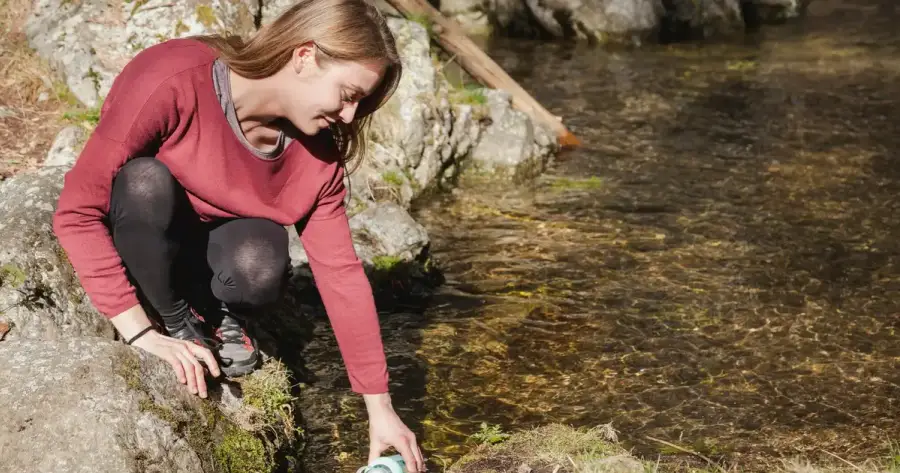
LifeStraw vs Sawyer: Best Water Filter for UK Emergency Kit
Build your personal emergency plan
Free, no sign-up, takes 5 minutes.
LifeStraw vs Sawyer is one of the most common questions reaching the EmergencyKitLab UK inbox. Both are well-known personal water filters, both sit around £30 to £40, and both are marketed as the cornerstone of any emergency kit. The reality is more nuanced. When Storm Eowyn knocked out power and water pressure across swathes of Scotland and Northern Ireland in January 2024, several readers wrote in asking whether their LifeStraw would let them safely use water from a communal tank or a garden butt. The honest answer was: it depends. At EmergencyKitLab UK we tested both filters against real scenarios: mains water cut, public fountain refill, and the murky water from a smallholding’s irrigation pond.
This comparison between the LifeStraw Peak Squeeze and the Sawyer Mini works through the technical differences that actually matter, the situations where each pulls ahead, and a final recommendation for different reader profiles.
Comparison table: LifeStraw Peak Squeeze vs Sawyer Mini
| Spec | LifeStraw Peak Squeeze 1L | Sawyer Mini SP128 |
|---|---|---|
| Pore size | 0.2 microns | 0.1 microns |
| Stated capacity | 2,000 litres | 378,000 litres |
| Flow rate | Fast (squeeze bottle) | Medium (manual pressure) |
| Weight | ~95 g with flask | 57 g |
| Bacteria removal | 99.999999% | 99.999999% |
| Protozoa removal | 99.999% | 99.9999% |
| Viruses | No | No |
| Backwashable | Yes, syringe sold separately | Yes, syringe included |
| Price on Amazon UK | ~£36 | ~£32 |
| Amazon rating | 4.5 / 5 | 4.7 / 5 |
The headline numbers: the Sawyer Mini has a finer pore (0.1 vs 0.2 microns), weighs roughly half, and has a much larger user base. The LifeStraw Peak Squeeze, on the other hand, comes ready as a one-litre squeeze flask and is more convenient for drinking on the move.
LifeStraw Peak Squeeze 1L in detail
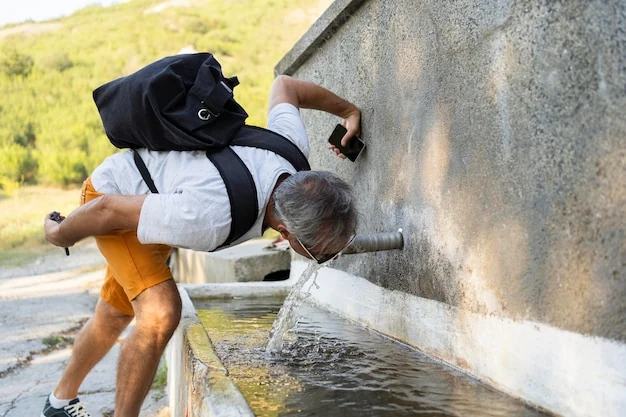
The Peak Squeeze is the evolution of the classic LifeStraw Personal. The American brand partnered with outdoor designers to ship a complete kit: a one-litre TPU collapsible flask resistant to punctures, a 0.2 micron filter that threads onto the cap, and a universal screw thread compatible with many standard bottles. It works well as a self-contained system for hiking or short evacuations.
What the team likes:
- Collapsible flask takes almost no space when empty (useful in a 72-hour bag)
- Drink directly through the filter without strong suction; kids and older relatives manage fine
- TPU flask tolerates a freeze if drained beforehand (the body, not the membrane)
- Compatible with Peak Series accessories if you later want to expand to 3L or 8L gravity systems
Where it falls short:
- 2,000 litres of stated capacity is modest compared with the competition
- 0.2 micron pore is on the looser end of acceptable for emergency use
- At £36 it is no longer the cheap option it once was, and the original LifeStraw straw sits at half the price
Best for: a single-person 72-hour go-bag, weekend hill walking, international travel where tap water is unreliable.
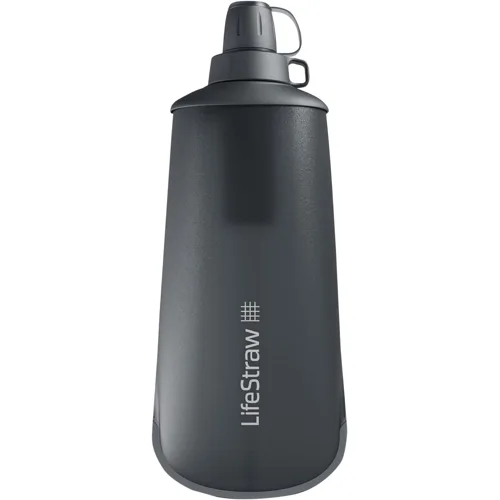
LifeStraw Peak Squeeze 1L
0.2 micron filter with a one-litre collapsible TPU flask. Complete drink-from-source system ready for an evacuation bag. Threads onto Peak Series accessories if you want to scale up later.
Sawyer Mini SP128 in detail
The Sawyer Mini has been on the market for more than a decade and has become the reference filter for American thru-hikers and the European preparedness community alike. It weighs 57 grams, screws onto any standard soft-drink bottle (28 mm thread), and ships with a backwash syringe in the base kit. The 0.1 micron hollow-fibre membrane uses the same technology found in small-scale industrial water treatment plants.
What the team likes:
- 378,000 litre stated capacity (in clean water it is genuinely achievable; in murky water it is still vastly more than you will use)
- 4.7 stars with thousands of reviews on Amazon UK; the user base speaks for itself
- Half the weight of any alternative with a flask included
- Versatility: screws onto squeeze bags, soft-drink bottles, direct suction, or hangs as a gravity system
Where it falls short:
- No flask in the box, so you have to buy one or repurpose a soft-drink bottle
- Slower flow rate than the LifeStraw Peak, requires patient squeezing
- The backwash syringe is bulky for a minimalist bag
Best for: a household emergency kit, a 2–4 person evacuation bag, base camp in rural areas, backup planning for storm-related power cuts or mains water disruption.
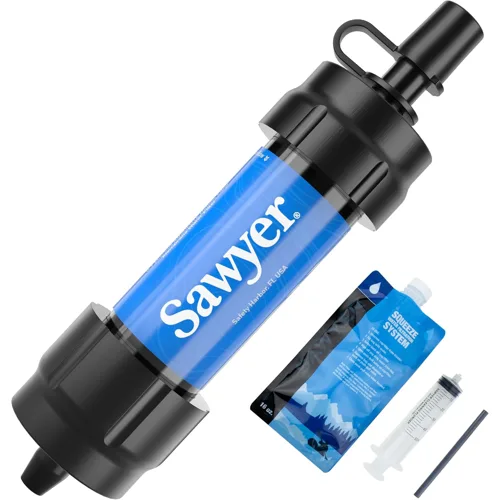
Sawyer Mini SP128
0.1 micron hollow-fibre filter. 57 grams. 378,000 litres stated capacity. Screws onto any standard soft-drink bottle. Backwash syringe included.
Which one for your situation
There is no single right answer. It depends on the scenario you are covering.
Building a single-person 72-hour go-bag: LifeStraw Peak Squeeze. The one-litre flask saves you having to pack a separate bottle. It weighs about the same as a Sawyer plus a repurposed bottle, and you drink straight from the filter without squeezing.
Kitting out a family emergency kit at home: Sawyer Mini. The stated 378,000 litre capacity covers years of use without replacement, even if you discount it by 75% for turbid water. Paired with a Cnoc 2-litre squeeze bag (sold separately for around £25) it gives a family of four filtered water for weeks without replacing the filter.
Living in a flood-prone area along the Severn, the Thames or coastal Wales: Sawyer Mini plus a packet of Aquatabs purification tablets. The filter strips out sediment and large pathogens, the tablets neutralise viruses the filter misses. This combination is what we recommend in the 72-hour survival bag checklist.
Taking the filter on international travel: either will do. In urban Southeast Asia or Latin America, add tablets: hepatitis A and norovirus risk in tap or well water is real and neither filter stops viruses on its own.
You have £35 and want the best: Sawyer Mini. The capacity-to-price ratio is unmatched, and you can add a flask of your choice later.
The EmergencyKitLab UK team verdict
For 80% of readers, the Sawyer Mini is the sensible choice. It has a finer pore, incomparable capacity, and a user base of thousands of validated reviews on Amazon UK. EmergencyKitLab UK recommends it as the base filter for any household emergency kit.
The LifeStraw Peak Squeeze wins in one specific case: when you want a 100% ready-to-go system without having to think about which bottle to attach the filter to. For a minimalist single-person go-bag, the simplicity of the Peak Squeeze has real value. But that value costs 200x less stated capacity and a slightly looser pore.
The team rejected the “buy both” route because it offers no useful redundancy. If you want real redundancy, pair a filter with purification tablets; they cover different risks. Aquatabs cost around £8 for a strip that treats hundreds of litres and slot neatly into the same kit pocket.
A note on Storm Eowyn (January 2024): several rural households in Argyll and the Highlands lost mains water pressure for hours because the local pumping stations rely on grid electricity. Whoever owned a personal filter could draw from a stream or a stored tank that had become cloudy after sediment was disturbed. The Sawyer Mini coped without complaint after a quick backwash every five litres or so. The older LifeStraw Personal clogged faster and demanded the syringe every two litres. That is anecdote rather than study, but it lines up with what other UK preparedness readers reported afterwards.
More water-side reading
If you are building the water portion of your kit from scratch, start with the broader emergency preparedness ultimate guide. The filter is just one link. Without a baseline reserve of two litres per person per day, no filter will dig you out of the first 24 hours — our emergency water storage guide covers how much to hold back and how to keep it potable.
For the full picture on go-bags, lessons from a 5-day blackout covers what actually broke down at hour 12, hour 36 and day three, with water front and centre.
Need to know how many litres and which type of filter for your specific household? The EmergencyKitLab UK planner calculates your water needs by household size, scenario and days of autonomy.
Some links are Amazon affiliate links, at no extra cost to you. Prices and ratings were verified in May 2026 and may vary.
Prices are indicative and may vary on Amazon.
Looking for products mentioned in this article?
Products reviewed by our team on Amazon, all rated 4+ stars.
UK emergency preparedness editorial team
The EmergencyKitLab UK editorial team produces straightforward preparedness advice for British households facing Atlantic storms, flooding, power cuts, cold snaps and heatwaves. We focus on affordable steps that work in typical UK homes, including flats with limited storage.
Frequently Asked Questions
Can the LifeStraw Peak Squeeze screw onto a standard UK bottle?
How many litres does a Sawyer Mini realistically filter from murky UK flood water?
Will the LifeStraw Peak Squeeze remove viruses from urban flood water?
Which is lighter for a UK go-bag built around the 25 lb rule?
Can these filters be stored in the car boot through a British winter?
Related Articles
72-Hour Survival Bag: Complete Checklist Organized by Weight
What to pack in your 72-hour survival bag and how to organise it so you can find everything in the dark. Full checklist with real weights and priority order.
9 min readEmergency Preparedness: The Ultimate Guide for UK Families
Complete emergency preparedness guide for British households. gov.uk/prepare-based checklists, real budgets, and the mistakes most people make.
18 min read5-Day Blackout: Real Lessons from Losing Power for a Week
True account of a 5-day power outage: the mistakes we made, what saved the situation, and what we changed afterward. Honest preparedness lessons.
7 min read