Anker SOLIX C1000 vs EcoFlow RIVER 2 MAX: UK Power Cut
Build your plan for Blackout
Free, no sign-up, takes 5 minutes.
Anker SOLIX C1000 vs EcoFlow RIVER 2 MAX is the comparison most requested by EmergencyKitLab UK readers since Storm Eowyn brought down power lines across Scotland and Northern Ireland in January 2024, leaving tens of thousands of homes without electricity for two to five days. The households who owned a decent power station charged phones, kept a small fridge alive and listened to radio updates. The ones who did not depended on luck and warm friends. At EmergencyKitLab UK we tested both models over six months across different scenarios: planned power cut, base camp in a rural cottage, and daily desk use as a UPS for the home office.
This comparison between the Anker SOLIX C1000 and the EcoFlow RIVER 2 MAX looks at real capacity, continuous power, recharge speed, noise and price. The conclusion is that they are not in the same league, but the decision depends on what you are covering: an overnight power cut in a flat, a weekend in a remote cottage, or a semi-permanent household backup.
Comparison table: Anker SOLIX C1000 vs EcoFlow RIVER 2 MAX
| Spec | Anker SOLIX C1000 | EcoFlow RIVER 2 MAX |
|---|---|---|
| Battery capacity | 1056 Wh | 512 Wh |
| AC continuous output | 1500W (SurgePad 2000W) | 1000W (X-Boost virtual) |
| AC sockets (UK 3-pin) | 4 | 3 |
| USB-C / USB-A | 2 USB-C (100W max) + 2 USB-A | 1 USB-C (100W) + 2 USB-A |
| 12V car output | Yes (10A) | Yes (10A) |
| Time mains 0–100% | 58 minutes | 60 minutes |
| Max solar input | 600W | 220W |
| Battery | LiFePO4 (3,000 cycles) | LiFePO4 (3,000 cycles) |
| Weight | 12.9 kg | 6.1 kg |
| Max fan noise | 40 dB | 38 dB |
| Mobile app | Yes (Anker) | Yes (EcoFlow) |
| Price on Amazon UK | ~£499 | ~£369 |
| Amazon rating | 4.7 / 5 | 4.4 / 5 |
The most relevant figure: the SOLIX C1000 has twice the capacity and 50% more continuous power. The RIVER 2 MAX weighs less than half and costs around £130 less. They are not the same category of product.
Anker SOLIX C1000 in detail

The SOLIX C1000 is Anker’s offer for the upper-mid household market. 1056 Wh of capacity, enough to cover most needs of a 12–24 hour power cut in a 2–4 person home. The battery is LiFePO4, the safest and most durable chemistry available, with 3,000 cycles to 80% capacity (a realistic 15–20 years of moderate use).
What the team likes:
- 1500W continuous handles large fridges, 1200W microwaves, electric kettles, drills, almost any household tool
- Mains 0–100% in 58 minutes: useful if you have warning of a planned outage or a major storm forecast
- 600W solar input allows recharge in 2–3 hours with a decent panel
- Four UK 3-pin sockets: you can simultaneously run a fridge, router, LED lighting and chargers
- Anker app is stable and useful for scheduling charges, monitoring state, adjusting discharge curves
Where it falls short:
- 12.9 kg is not truly portable — you do not carry it in a go-bag or during evacuation
- £499 is a serious commitment that only makes sense if a long power cut is realistic for your area
- The compatible solar panel is sold separately (not included) and adds another £200 to £400
Best for: a semi-permanent household kit, plan B for 12–48 hour power cuts, supporting light medical equipment (CPAP, nebuliser) when mains is down.
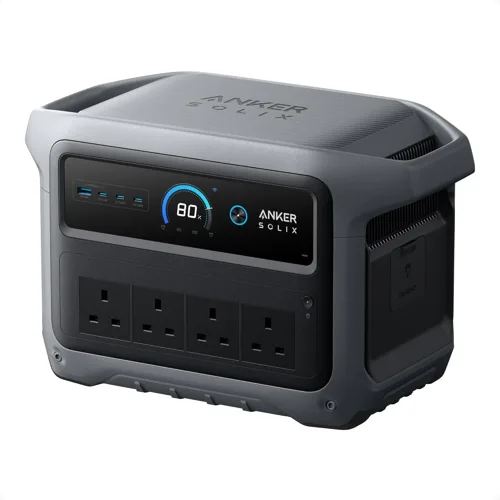
Anker SOLIX C1000
1056 Wh power station with 1500W continuous (2000W peak). Charges to 100% in 58 minutes. LiFePO4 battery rated 3,000 cycles. Four UK sockets, USB-C 100W, 600W solar input.
EcoFlow RIVER 2 MAX in detail

The RIVER 2 MAX is EcoFlow’s answer for the mid-market. 512 Wh capacity and 1000W continuous output, enough for more modest scenarios: 6–8 hours of fridge runtime, multiple phone charges for the whole family, LED lighting all night, Wi-Fi router for a full day if the cable from your ISP is still up.
What the team likes:
- 6.1 kg of real-world weight — you can move it between rooms, take it to the car, lend it to relatives
- Mains 0–100% in 60 minutes (similar to the SOLIX)
- X-Boost handles loads up to 1000W virtual (resistive appliances like kettles) by lowering voltage
- £369 sits in the reasonable range for users who will probably run it once or twice a year
- EcoFlow app is very mature — the brand has years of head start on remote-control software
Where it falls short:
- 512 Wh falls short for long power cuts: if the fridge averages 80W, that is just six hours
- 220W solar input limits panel recharging to slow rates
- Three sockets can be tight if you want to run fridge, lighting, router and an appliance at the same time
Best for: an urban flat with low risk of a long outage, a first-power-station kit for someone getting started, or expanding an existing small solar setup.
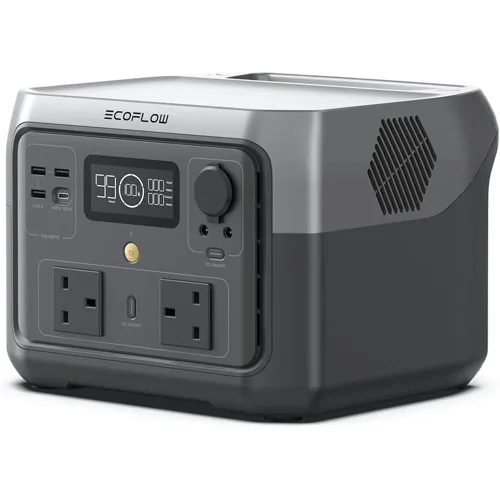
EcoFlow RIVER 2 MAX
Portable 512 Wh power station with 1000W continuous (X-Boost). Fast charge in 60 minutes. LiFePO4 battery. Three UK sockets, USB-C 100W, 220W solar input. 6.1 kg.
Which one for your situation
You live in a flat and the worst realistic case is a 4–8 hour power cut: EcoFlow RIVER 2 MAX. Covers the case comfortably, weighs half and costs £130 less. 512 Wh runs phones, router, LED lights and the fridge through most of the outage. For short scenarios you do not need more.
You live in an area with recurring power cuts (rural Scotland, Welsh valleys, coastal regions hit by Atlantic storms): Anker SOLIX C1000. The 1056 Wh + 1500W continuous is the difference between “we get through the night” and “we operate normally for 24 hours”. If your postcode has had more than one prolonged cut in the past three years, the extra spend pays for itself.
You depend on mains-powered medical equipment (CPAP, oxygen concentrator, nebuliser): SOLIX C1000 without hesitation. Capacity covers 8–10 hours of CPAP (average 30–40W) or several full nebuliser cycles. The RIVER 2 MAX may fall short for a full night of CPAP plus alarm plus phone charging. We cover this in the lessons from a 5-day blackout write-up.
You want to expand later with solar panels and extra batteries: SOLIX C1000. The 600W solar input and the Anker SOLIX ecosystem (SP100 panels, expansion battery) are better designed for growth.
You want it to double as a leisure tool (camping, motorhome, outdoor events): RIVER 2 MAX. Weight is the difference between “I bring it” and “it stays at home”. Six kilos is movable, 13 kilos is a conscious decision.
You only have £400 and want the best: RIVER 2 MAX. Good product for the price. Once your budget reaches £500, the balance tilts to the SOLIX on capacity and power.
The EmergencyKitLab UK team verdict
For the average EmergencyKitLab UK reader, the decision depends on the kind of power cut you are covering. If your area is low risk and you want a reasonable insurance policy, the EcoFlow RIVER 2 MAX delivers. If your area had prolonged outages in recent years or you depend on medical equipment, the Anker SOLIX C1000 is the sensible choice.
The team rejected the “buy the big one just in case” route when actual risk is low. It makes no sense to lock up £130 of extra capacity you will never use. By the same logic, the team rejected “buy the small one, you can scale later” when there is medical dependence or a plausible scenario of cuts lasting more than eight hours. The RIVER 2 MAX does not scale to the loads the SOLIX handles without effort.
A note from Storm Eowyn (January 2024): homes with a SOLIX C1000 fully charged at the start of the outage kept their fridges running for 14–16 hours without breaking the cold chain, kept everyone’s phones alive, and a couple of testers worked remotely from a laptop + router + monitor for four to five hours. Homes with a RIVER 2 MAX got the same but with six to eight hours of total autonomy. Anyone with nothing lost £200–£400 of fridge and freezer contents. In hindsight, neither investment looked expensive.
Resources for designing your energy plan
Before buying, read the 72-hour emergency kit for families guide — the energy section walks through power station options from 200 Wh to 3,000 Wh, and the right answer depends heavily on what you are actually trying to keep running.
To understand what happens in the first 24 hours of a household power cut and what you need ready before it arrives, lessons from a 5-day blackout covers the priority order minute by minute.
How many Wh do you need by family size, equipment and target outage duration? The EmergencyKitLab UK planner calculates your exact electrical reserve and tells you which appliances you can keep on.
Some links are Amazon affiliate links — no extra cost to you. Prices and ratings were verified in May 2026 and may vary.
Prices are indicative and may vary on Amazon.
Looking for products mentioned in this article?
Products reviewed by our team on Amazon, all rated 4+ stars.
Build your plan for Blackout
Exact quantities, verified products, and a personalized shopping list for Blackout. Free in 5 minutes.
Plan for BlackoutUK emergency preparedness editorial team
The EmergencyKitLab UK editorial team produces straightforward preparedness advice for British households facing Atlantic storms, flooding, power cuts, cold snaps and heatwaves. We focus on affordable steps that work in typical UK homes, including flats with limited storage.
Frequently Asked Questions
How many hours will a 200W fridge run on an Anker SOLIX C1000?
Can either station be topped up with a small solar panel?
Which is quieter? Important for a flat with neighbours.
Which can start a fridge motor or a high-wattage microwave?
Will the LiFePO4 battery actually last years of real use?
Related Articles
72-Hour Emergency Kit 2026: Checklist + Budget (Family)
EmergencyKitLab 2026 guide: complete 72-hour kit checklist from £50/person. Winter Storm Uri-tested tips + the #1 water mistake families still make.
15 min readEmergency Preparedness: The Ultimate Guide for UK Families
Complete emergency preparedness guide for British households. gov.uk/prepare-based checklists, real budgets, and the mistakes most people make.
18 min read5-Day Blackout: Real Lessons from Losing Power for a Week
True account of a 5-day power outage: the mistakes we made, what saved the situation, and what we changed afterward. Honest preparedness lessons.
7 min read